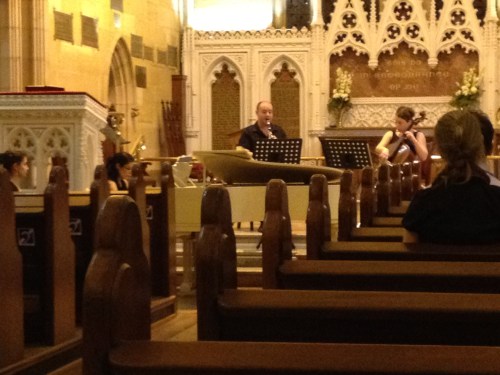
Rehearsals have started with the Bancroft String Quartet

Our final concert for 2012 is coming up on Saturday 10th November, 7.30pm at the St Philip’s Church York Street, Sydney.

We are excited to have some of the members from the Bancroft Quartet to perform the Brahms Clarinet Quintet with clarinetist Ian Sykes. More details to follow soon.

When: Saturday 10th November, 7.30pm

Where: St Philip’s Anglican Church, 3 York St, Sydney

Tickets: $15-$35

Bookings: http://www.trybooking.com/BQPK

Leave a comment

October 8, 2012 · 6:24 pm

Spring is here… join us for Classical Inspirations

Cherry blossom

Cherry blossom (Photo credit: Ana Gasston)

I can feel it in the air, and as I walk past the blossoming cheery trees down the street, Spring is definitely here. And what better way to celebrate than with a concert program filled with youthful and bright music.


This Saturday, the first day of Spring, we explore the early Classical masters and the influence that the Classical and Romantic tradition had on young impressionable composers. Beethoven’s Quintet for piano and winds is a youthful homage to Mozart, emulating the elder composer while establishing his own clear voice. The Clarinet Sonata is one of Bernstein’s first published compositions, of which the form and style is closely aligned to the Romantic tradition. Mozart was already an established composer by the time he composed the Kegelstatt Trio, supposedly for one of his best piano pupils. Carl Nielsen’s Wind Quintet remains his most performed composition due to the unique combination of capturing the character of the performers in his music, the use of traditional folk song in a chorale setting, and a structure firmly rooted in the Classical tradition.


Beethoven – Quintet for piano and winds, Op. 16


Much like his string quartets (Op. 18) that Beethoven was writing at the same time the composition reflects the influence of his older peers, Mozart and Haydn. In fact the quintet closely mimics Mozart’s Quintet for the same instruments and composed in the same key of E flat, K. 452 (written in 1784). and even has similar tempi for each movements. Even though Beethoven’s writing for the winds closely follows the style of Mozart’s wind serenades, Beethoven does assert his personality through the forceful writing for the piano. An alternate version with the same opus number is written for piano, violin, viola and cello. Both works were dedicated to Prince Joseph Johann zu Schwarzenberg.


Bernstein – Sonata for clarinet and piano


One of America’s most remarkable and versatile musicians, Leonard Bernstein was a composer, conductor, pianist and educator. Although most famous as a conductor, and for his score for the musical West Side Story, Bernstein was a prolific composer, writing symphonies, operas, choral and piano music. The Sonata is dedicated to clarinetist David Oppenheim, whom Bernstein met during the Tanglewood summer season of 1942.


Mozart – Trio for clarinet, viola and piano K.498


From the first time he heard the clarinet in the famous orchestra at Mannheim in 1778, Mozart was entranced by its beautiful tone. Writing to his father Mozart declared, “you can’t guess the lordly effect of symphony with flutes, oboes and clarinets”. Although Mozart used clarinets that year in his Paris Symphony (no. 31), it wasn’t until his friendship with clarinetist and fellow Freemason Anton Stadler was established in Vienna that he began to write for the instrument with the virtuosity well known from his Clarinet Concerto and Clarinet Quintet of 1789.


Nielsen – Wind Quintet


Carl Nielsen’s Wind Quintet is one of the key works of the wind quintet repertoire. It is modern yet very accessible, and while each instrument has a distinct voice, the whole is expressive and cohesive. In 1921 Nielsen was inspired to compose a wind quintet after overhearing a rehearsal of Mozart’s Sinfonia Concertante by members of the Copenhagen Wind Quintet. Nielsen’s wind quintet was then dedicated to the ensemble and they premiered the quintet in 1922.

–  Notes, by Ian Sykes, Clare Kahn and Alison Evans.


I hope that you may be able to join us!


When: Saturday 1st September, 7.30pm

Where: St Philip’s Anglican Church, 3 York St, Sydney

Tickets: $15-$35


Bookings: http://www.trybooking.com/BQPF
 

Leave a comment

Filed under Concerts

Classical Inspirations

Grave of Leonard Bernstein, an American conduc...

Grave of Leonard Bernstein, an American conductor, composer in Green-Wood Cemetery, Brooklyn, New York. (Photo credit: Wikipedia)

Join Sirius Chamber Ensemble as we explore a variety of repertoire inspired by early masters. The Quintet for piano and winds by Ludwig van Beethoven is a youthful homage to Mozart, emulating the elder composer’s quintet but establishing a clearly unique voice.

One of his first published compositions, the form and style of the Clarinet Sonata by Leonard Bernstein is closely aligned to the Romantic tradition, although the sweeping lines and rhythmic drive foreshadow the popular tunes of West Side Story.

The Wind Quintet by one of Denmark’s greatest 20th-century composers, Carl Nielsen remains his most performed composition. Written for the performers of the Copenhagen Wind Quintet, Nielsen captured the character of each performer in the instrumentation of the music. The theme in the final movement was Nielsen’s own melody used for the spiritual song, My Jesus, make my heart to love thee. The structure of the work is firmly rooted in the Classical tradition.

Also on the program is Mozart’s “Kegelstatt” trio for clarinet, viola and piano, popularly known to be composed during a game of skittles.

When: Saturday 1st September, 7.30pm

Where: St Philip’s Anglican Church, 3 York St, Sydney

Tickets: $15-$35

Bookings: http://www.trybooking.com/BQPF

Leave a comment

Filed under Concerts

Spring programs

Whilst now we have the winter months to endure we can take pleasure knowing that Spring will appear eventually. And with it another program of classical chamber repertoire.

English: Spring flowers in England


Saturday 1st September, 7.30 pm at St Philip’s Church

On the first evening of Spring we will perform the Wind Quintet by Carl Nielsen, the Clarinet Sonata by Leonard Bernstein, the Kegelstatt Trio for clarinet, viola and piano, and the Quintet for piano and winds by Beethoven.


Saturday 10th November, 7.30 pm at St Philip’s Church

Our last program for 2012 concert series we are very excited to be performing the premiere of Mestizo Dances composed especially for Sirius Chamber Ensemble by Nigel Ubrihien. Other works on the program include Brahms Clarinet Quintet, Arnold trio for flute, viola, and bassoon; and La Revue de Cuisine by Bohuslav Martinu.


Please note the later concert time for these concerts. Stay tuned for booking details.


Leave a comment

Filed under Concerts

Messiaen in May

Firstly, we would like to thank Helen Vidovich for performing with us last month while she was home from the U.K. It was great to see Helen again and hear her beautiful playing. For those of you who would like to follow where Helen and Trio Marsyas are performing next visit their website.

Next month we will be performing again at St Philip’s Church. It will be a diverse program including the sombre ‘Quartet for the end of time by Olivier Messiaen, contrasted with the more optimistic Incantations for Wind Quintet by Ross Edwards. Also on the program will be a repeat performance of the Clarinet Trio in Bb, Op 11 by Beethoven.

Composed as a prisoner-of-war on a scrap of paper with a borrowed pencil, the Quartet for the end of time (1940-41) was performed on old, broken instruments by fellow prisoners in the  Stalag VIII-A in Görlitz, Germany on January 15, 1941. The work, in eight movements, was inspired by the text from the Book of Revelation. One can not imagine what was in the minds of the performers or the audience members while they sat in the rain listening, perhaps with some solace to this music. Despite the solemnity of the work, Messiaen drew inspiration for nature as well. In particular, the first movement for the whole quartet depicts the sounds of awakening birds. Messiaen wrote in the score the following description,

Between three and four in the morning, the awakening of birds: a solo blackbird or nightingale improvises, surrounded by a shimmer of sound, by a halo of trills lost very high in the trees. Transpose this onto a religious plane and you have the harmonious silence of Heaven.

The Incantations for Wind Quintet (2006) by Ross Edwards is the revised version of Maninya III (1985) . Like most of Edwards’ compositions the work depicts sounds from nature especially that of birdsong.

For the Clarinet trio in Bb, Op 11 (1798) Beethoven may not have used birds for inspiration but the theme of third movement was taken from a popular street song at the time. Descriptions of this work does not sound like the typical Beethoven. Indeed, ‘light’ and ‘gentle’ and words not often associated with Beethoven. Written when he was only 28 the three movement work for clarinet, cello and piano is lyrical and playful at heart.

When: Saturday 19 May, 7.00pm
Where: St Philip’s Church, 3 York Street, Sydney
Tickets: Adults $35; Student/Concession $25; Child (12 years and under) $15
Bookings online: try booking 

Leave a comment

Filed under Concerts

Claire Howard-Race, Helen Vidovich, Ian Sykes and Clare Kahn

Claire Howard-Race, Helen Vidovich, Ian Sykes and Clare Kahn

Lullaby for four by Adrienne Albert for Flute, Clarinet, Cello and Piano performed 4th April at St Philip’s Church.

Leave a comment

April 8, 2012 · 6:56 am

Claire Howard-Race, Ian Sykes and Clare Kahn

Claire Howard-Race, Ian Sykes and Clare Kahn

Beethoven Trio for Clarinet, Cello and Piano performed 4th April at St Philip’s Church.

Leave a comment

April 8, 2012 · 6:53 am

Premieres of new arrangements by Adrienne Albert

Our upcoming concert next Wednesday 4th April at 7pm with Helen Vidovich (flute), Sirius Chamber Ensemble will be performing two pieces by US composer Adrienne Albert arranged for flute, clarinet, cello and piano.

Lullaby for Four and Doppler Effect for flute, clarinet, cello and piano

American composer Adrienne Albert (1941 -­‐) was born into a musical family and studied piano, violin and composition from an early age. As a mezzo­‐soprano, Albert collaborated with some of the twentieth century’s most in<luential composers including Igor Stravinsky, Leonard Bernstein and Philip Glass. In the 1990s she began composing her own music, including major symphonic and choral works as well as a variety of more intimate chamber pieces. Adrienne Albert’s music has become widely known for its “melodic and lyrical beauty” as well as its “whimsy and playfulness”.

Albert has arranged and adapted much of her music for varying ensembles, with Doppler Effect being the premiere of her fourteenth arrangement of the work! Lullaby began life in 2007 as the middle movement of a chamber work for flute, violin, viola, cello and harp, but was extended and adapted as Lullaby for Three for flute, viola and harp in 2011. Tonight’s performance is the premiere of Albert’s new version, Lullaby for Four for flute, clarinet, cello and piano. Albert says of the work:

“Lullaby is a gentle song featuring the voices of the individual instruments. As my former musical life included being a singer, I ask myself if each musical line can be sung and if so, then it follows that it should sound good on an instrument. Although I wrote the notes, the shape and intention of the music can only come to life through the collaborative process of the musicians interpreting what I have written.”

Doppler Effect was originally composed for flute, viola and harp.

“The notion of writing a piece based on the <indings of an Austrian mathematician who observed the increase and decrease in the pitch of sound when the source and observer are getting closer or further apart came to me while traveling through Italy and hearing the myriad sirens passing by through the dense traffic. The motif descends by a minor second returning to the original harmony combined with the repeated minor seconds portraying the incessant sounds of car horns. The melodic lines portray the vibrancy and sensuality of the people in contrast to the craziness around them.”


© Adrienne Albert, http://www.adriennealbert.com 

Tickets available through try booking and at the door.

$35 Adults / $25 Concession/ $15 Children (12 & under)

1 Comment

Filed under Concerts

Beethoven Clarinet Trio Op. 11

Ludwig van Beethoven (1770-1827 ) is today one of the most performed and loved composers, whose music is considered by many to be the pinnacle of musical genius, defining all that was to follow. Beethoven’s early compositions are therefore particularly intriguing, as they show the young composer, still strongly influenced by his teachers and the fashions of the time, while also displaying glimpses of an independence that would in time change musical composition forever.

Ludwig van Beethoven in 1803

Ludwig van Beethoven in 1803 (Photo credit: Wikipedia)

After Haydn heard some of Beethoven’s early compositions during a visit to Bonn in 1792 he invited the young composer to come to Vienna to study with him there. Beethoven took up the offer, and although the lessons were not entirely successful, many important compositions, including the Clarinet trio in Bb Op. 11, were products of his time studying in Vienna and these compositions still show a strong relationship to Haydn’s work. Beethoven’s own voice is also apparent nonetheless – in the use of sudden, extreme dynamics and in the light-hearted set of variations on a theme from a popular opera that conclude the work. But perhaps the greatest sign of Beethoven’s genius lies in the real heart of this clarinet trio, the profoundly moving second movement. The trio was written in 1798, the same year Beethoven discovered he was losing his hearing. We cannot really know what influence this event had on his work, but nonetheless the terrible tragedy of his affliction makes this singing, mournful movement even more affecting.

– Notes by Clare Kahn (cello)

Concert on Wednesday 4th April, 7pm 

St Philip’s Anglican Church, 3 York Street, Sydney

Tickets can be purchased online here or at the door

$35 Adults/ $25 Concession / $15 Children (12 & under)

Leave a comment

Filed under Concerts

Highlights from concert in August 2011

“we do not remember days… we remember moments.” – Cesare Pavese

Here are two moments captured from our August concert last year. The mournful second movement from Muczynski Fantasy Trio for Clarinet, Cello and Piano and the bright and cheerful third movement from Mozart Quintet for Piano and Winds. We were fortunate to have some fantastic musicians join us for our concert series last year. And we look forward to an even more exciting program this year. Hope you enjoy these highlights.

Click here to listen to

Sirius Chamber Ensemble performing Muczynski

Click here to listen to

Sirius Chamber Ensemble performing Mozart

Leave a comment

Filed under Concerts