Tag Archives: Bohuslav Martinu

Sirius announces 2013 Concert Series

We are pleased to announce our 2013 concert series at St Philip’s Church, York St Sydney. We will be presenting three concerts this year, and for the first time are offering subscription tickets for the entire series.

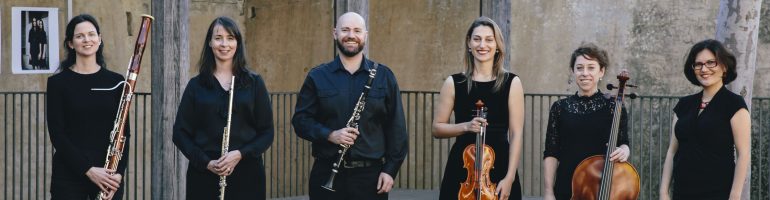
Our core ensemble of Ian Sykes (clarinet), Alison Evans (bassoon), Melissa Coleman (flute), Julia Zeltzer (french horn), Georgina Price (viola), Clare Kahn (cello) and Claire Howard Race (piano) will be returning to present an even more diverse range of works this year.

Prokofiev, Shostakovich and Khachaturian 1940

Concert 1 – Saturday 25th May, 7.30pm

The Voice of Exile

Sirius Chamber Ensemble focuses on composers known to have worked under the communist regimes in the former Soviet Union. Despite heavy censorship, fear of deportation or death, composers in this period produced some of the most profound music of the twentieth century.

Dimitri Shostakovich – Piano Trio No.2.

Sergei Prokofiev – Flute Sonata Op.94

Bohuslav Martinu – Nonet for flute, oboe, clarinet, bassoon, french horn, violin, viola, cello and bass.

Guest Artists: Angus Lindsay (oboe), Martyn Hentschel (violin), Heloise Meisel (violin), Andrew Meisel (bass).

Concert 2 – Saturday 10th August, 7.30pm

The Americas

Join Sirius Chamber Ensemble for a musical journey through the Americas. Beginning in Brazil with the wind quintet “Quintette en forme de Choros” by Heitor Villa-Lobos and then following to Argentina for “Le Grand Tango” for cello and piano by Astor Piazzolla. Venturing further north, we get a taste of the United States with a pastoral “Quiet in the Land” for flute, clarinet, cor anglais, viola and cello by Kenneth Fuchs and the Trio for clarinet, cello and piano by Robert Muczynski. To conclude is the joyous “Belle Epoque in Sud America” for wind quintet by Brazilian composer Julio Medaglia.

Concert 3 – Saturday 30th November, 7.30pm

Eastern Europe

Sirius Chamber Ensemble travels on a journey through the tumultuous history of Hungary and Czechoslovakia. The use of folk songs and national dance in the music of Béla Bartók and Antonín Dvořák inspired later composers such as György Ligeti. Sirius will premiere a new work by Nigel Ubrihien, an arrangement of Hungarian folk songs for vocalist and chamber ensemble.

Béla Bartók – “Contrasts” for clarinet, violin and piano

György Ligeti – Six Bagatelles for wind quintet

Nigel Ubrihien – new work

Antonín Dvořák – Piano Quintet No. 2 in A major, Op.81

Tickets are available for sale now at www.classikon.com

Single Tickets:

Adult $35 / Concession $25 / Child $15

3 Concert Subscription:

Adult $90 / Concession $65 / Child $30

We look forward to a great year of music making, and hope to see you at a concert soon.

Ian Sykes and Alison Evans

Sirius Chamber Ensemble

Contact us: sirius.ensemble@gmail.com

Leave a comment

Filed under Concerts

The Kitchen Review

English: Bohuslav Martinů (Martinu) ( ˈmarcɪnu...

English: Bohuslav Martinů (Martinu) ( ˈmarcɪnuː (help·info); (December 8, 1890 – August 28, 1959) was a prolific Bohemian Czech composer, who wrote six symphonies, 15 operas, 14 ballet scores and a large body of orchestral, chamber, vocal and instrumental works. (Photo credit: Wikipedia)

During the 1920s F. Scott Fitzgerald’s aptly named “Jazz Age” swept North America.  Likewise, Europe was exposed to current musical flavours and the Czech composer Bohuslav Martinu was not immune to the trends.  In 1927 Martinu wrote the 10-movement jazz ballet The Temptation of the Saintly Pot, incorporating the popular Charleston, Tango and the Foxtrot dances to complement the unlikely tale of a kitchen utensil love-triangle.  Martinu condensed the ballet into a 4-movement suite and under the new title of La Revue de Cuisine “The Kitchen Revue”, the suite was premiered in Paris in 1930.


The suite maintains the original instrumentation of the ballet; violin, cello, clarinet, bassoon, trumpet and piano.  With this combination, Martinu demonstrated the possibilities of jazz in a chamber ensemble without percussion.  In Martinu’s mind his native Slav folk songs contained a rhythmic parallel to jazz, as he observed,


“I often think of the amazingly pregnant rhythm … of our Slovak songs, of their characteristic, rhythmical, instrumental accompaniment, and it seems to me that it is unnecessary for us to have recourse to the jazz band.  Nevertheless I cannot deny the part [jazz] plays in the stream of our life … It is another question, however, how this influence should be realised.” (Quoted in Bohuslav Martinu His Life and Works, Safranek, M., London:  Alan Wingate, 1962, p.117).


In La Revue de Cuisine, Martinu has realised the jazz influence through such features as the Dixie-style clarinet writing, the shifting meters of the piano’s rhythmic role, the jazz band colour of the muted trumpet, and the witty soloistic interchanges between instruments.

– Notes by Claire Howard Race

Sirius Chamber Ensemble and guest artists will perform Saturday 10th November 2012, 7.30pm at the St Philip’s Church.

Tickets available on trybooking.com or at the door.

1 Comment

Filed under Concerts

Sirius Chamber Ensemble – Mestizo Dances

Josephine Baker dancing the Charleston at the ...

Josephine Baker dancing the Charleston at the Folies Bergère, Paris — Revue Nègre Dance (Photo credit: Wikipedia)

Sirius Chamber Ensemble concludes its 2012 concert series on a bright note, combining well-loved masterpieces, a jazz ballet suite and the premiere of a new composition written especially for the ensemble. Sydney-based composer, arranger and performer Nigel Ubrihien composed the septet Mestizo Dances after his travels in Mexico and is written for the unusual mix of wind and string instruments – flute, clarinet, bassoon, french horn, violin, viola and cello.

To continue the dance theme of the program, Bohuslav Martinu’s ballet suite La Revue de Cuisine based on the bizarre story of kitchen utensils dancing and falling in love on stage. The composition scored for a sextet – clarinet, bassoon, trumpet, violin, cello and piano – explores the popular jazz styles of the 1920’s.

Clarinetist Ian Sykes will be joined by the Bancroft Quartet to perform Brahms’ Clarinet Quintet Op.115. One of Brahms’ later works modelled on Mozart’s Quartet for the same instrumentation; the Quintet is regarded to be one of his greatest compositions for chamber ensemble.

Also on the program will be the lesser-known Trio for flute, viola and bassoon by Malcolm Arnold.


When: Saturday 10th November, 7.30pm

Where: St Philip’s Anglican Church, 3 York St, Sydney

Tickets: $15-$35

Bookings: http://www.trybooking.com/BQPK

Leave a comment

Filed under Concerts